MemoHive Official Website › Dose Notes › Label arithmetic
What MemoHive's 1,030 mg Total Can And Cannot Tell You
A total at the foot of a Supplement Facts panel is a checkable fact. It can help a buyer see whether every named row is present and whether the rows add up. It cannot tell a buyer that the five ingredients were tested together, that the total is a studied dose, or what any person will experience.
- The arithmetic closes. The five printed rows add to 1,030 mg per two-capsule serving.
- The claim boundary stays put. A total describes the label; it is not a result from a MemoHive trial.
- Evidence stays separate. Each ingredient's record remains separate from the finished formula.
- The label still leads. Directions and cautions matter more than arithmetic for safe use.
The arithmetic is visible, and it closes
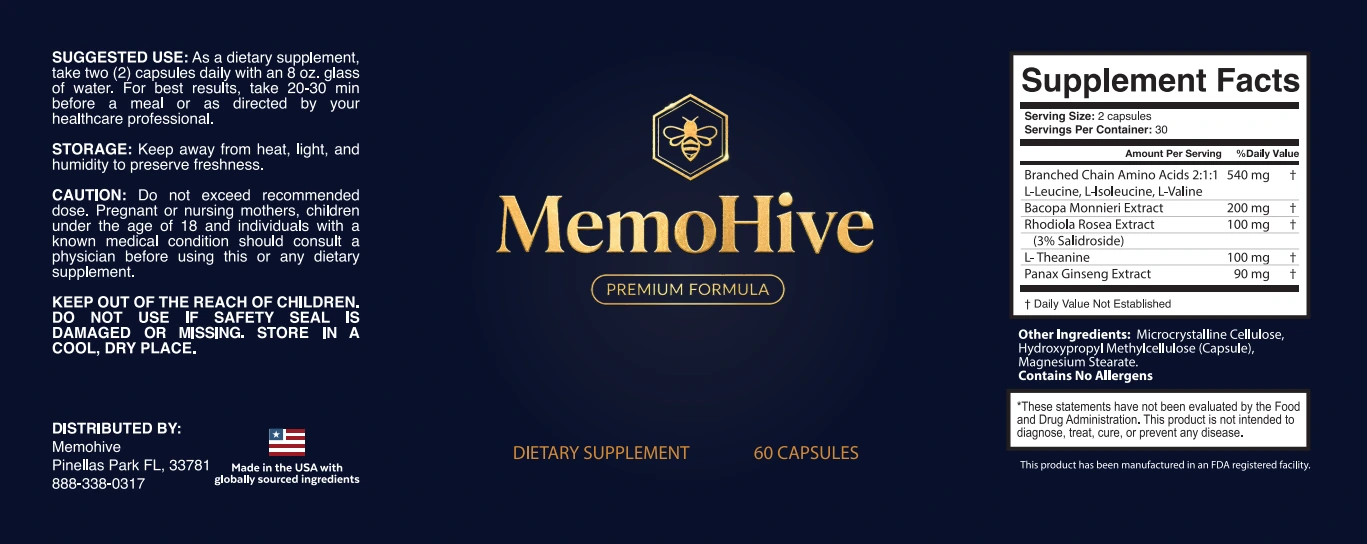
The MemoHive panel names five active rows for one two-capsule serving: branched chain amino acids 2:1:1 at 540 mg, bacopa monnieri extract at 200 mg, rhodiola rosea extract at 100 mg, L-theanine at 100 mg, and panax ginseng extract at 90 mg. Adding the five numbers produces 1,030 mg. The label gives a reader enough information to repeat that addition without guessing what is hidden inside a blend.
That is already more useful than a total by itself. A number printed as a proprietary blend total can conceal how the blend is divided. Here, the row values show that the BCAA line accounts for 540 of 1,030 mg, just over half of the stated serving. Bacopa contributes 200 mg; the next two rows contribute 100 mg each; and the ginseng row contributes 90 mg. The total is a summary of those named rows, not a sixth ingredient.
The unit matters as well. The total belongs to the serving printed on the panel, and the serving is two capsules. It is not a per-capsule figure, a bottle figure, or a statement about a day when a person takes more than the label directs. The bottle contains 60 capsules and 30 listed servings, so the count, total and directions need to travel together rather than being quoted one at a time.
| Printed row | Amount per two capsules | Share of the stated total |
|---|---|---|
| Branched chain amino acids 2:1:1 | 540 mg | about 52% |
| Bacopa monnieri extract | 200 mg | about 19% |
| Rhodiola rosea extract | 100 mg | about 10% |
| L-theanine | 100 mg | about 10% |
| Panax ginseng extract | 90 mg | about 9% |
| Total printed by the panel | 1,030 mg | 100% |
The percentages are arithmetic on the stated 1,030 mg total. They are not Daily Values, efficacy scores or a ranking of the ingredients.
What the total can help a buyer check
A complete total gives a buyer three modest but real checks. First, it lets the buyer compare the words on the front of a bottle with the rows on the back: a named ingredient that is absent from the facts panel is not supplied by a large total. Second, it lets the buyer notice the size of each row rather than assuming all five names make equal contributions. Third, it makes the serving size visible before a buyer compares one product's per-serving number with another product's per-capsule number.
It also gives a useful reason to read the non-active lines. The panel identifies the capsule shell as hydroxypropyl methylcellulose and names microcrystalline cellulose and magnesium stearate as other ingredients. It says no allergens are listed. Those statements answer label questions; they do not convert a total into an outcome claim. A transparent panel is a starting point for checking, not a conclusion.
The legal labeling rule supports that distinction. The Supplement Facts regulation requires a quantitative amount per serving for a listed dietary ingredient. It tells a buyer what the label must disclose. It does not say that a total amount has been clinically tested, and it does not let an advertiser turn disclosure into proof. That is why this article calls the arithmetic useful but stops there.
- Read the serving size before treating any milligram figure as comparable.
- Add named rows only when the panel gives a number for every row.
- Keep other ingredients, allergen language, storage and cautions in view.
- Look for a study of the actual formula before treating a formula total as a study dose.
See the full MemoHive panel
Five named rows, 1,030 mg per listed serving, 60 capsules and 30 servings to a bottle. Read the label and the purchase terms before ordering.
Order MemoHiveWhy it is not a trial dose
The phrase “1,030 mg” can sound precise enough to be evidence. It is precise as a label total; it is not a number published by a clinical trial of this five-ingredient formula. No source used on this site reports a study that administered MemoHive at 1,030 mg, and no article here describes the ingredients as working together. That missing study is the boundary, not a technicality.
The older dose notes show why a combined total would not solve the problem even if it looked convenient. The bacopa systematic review describes trials that used their own extract preparations and trial lengths. The L-theanine dose study tested L-theanine as its own intervention. The BCAA cognitive review found a small, mixed literature rather than a transferable formula result. Adding the amounts on this label cannot turn five separate records into a record for the combination.
A trial dose also carries details that a total leaves out: the exact extract or compound, the participants, comparison group, duration, outcome measure and attrition. Two products can share a total while differing in every one of those details. Conversely, two studies can use the same ingredient amount but have different extract standards or populations. The number on its own is not the study.
That is consistent with the broader consumer record. A systematic review of cognition supplements in healthy adults found a literature that was inconsistent and often imprecise, while a survey of memory supplements found varied ingredients and formulations across products. A neat total is not a shortcut around those limits.
A useful order of questions
For a buyer, the practical order is simpler than a formula verdict. Start with the label: does it state the serving, each active amount, the other ingredients and the caution language? Then ask whether any health condition, medicine or life stage makes the label's physician-consultation line relevant before starting. Finally, if the question is whether a supplement is likely to meet a personal goal, look for evidence about the exact product and keep individual-ingredient findings in their own lane.
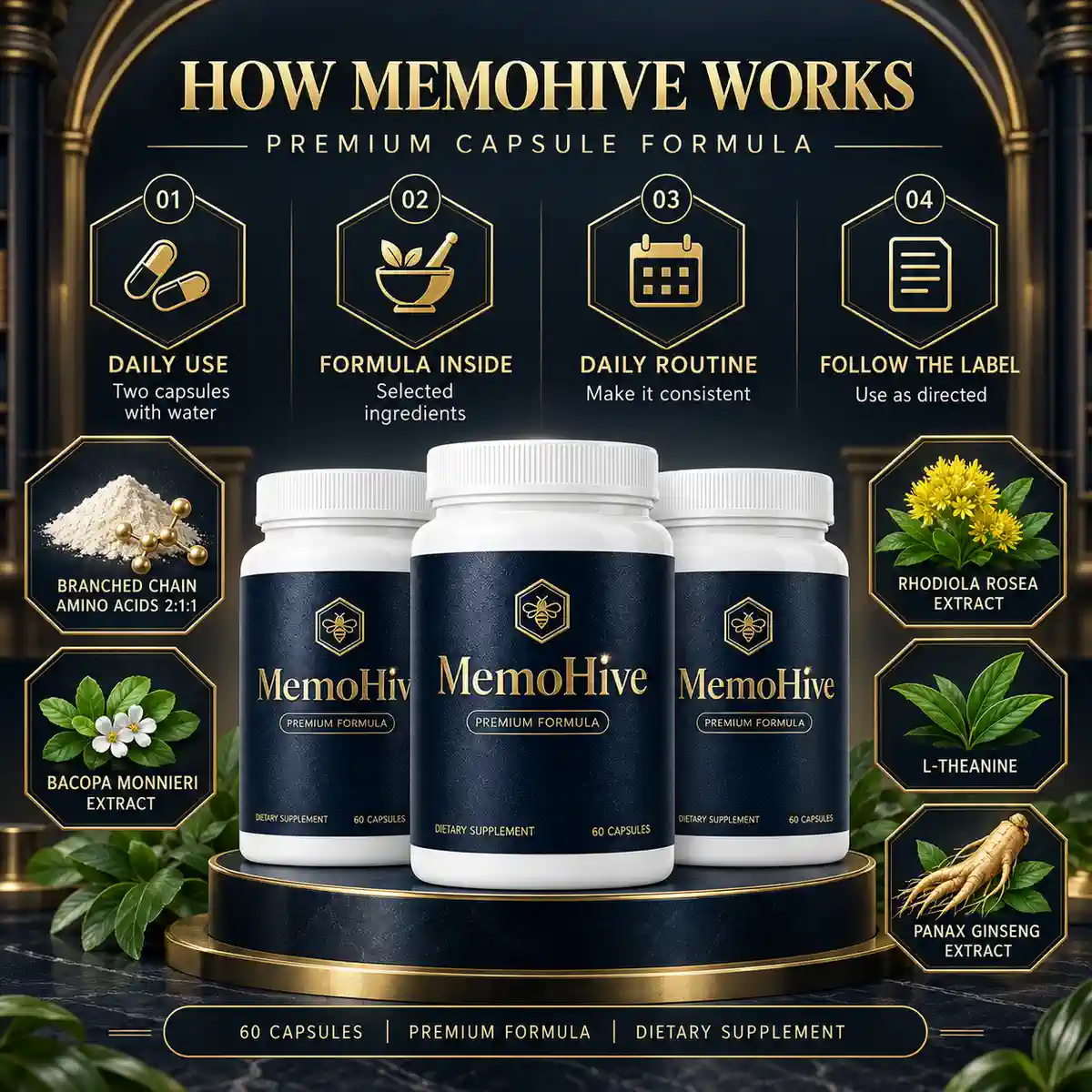
MemoHive's own directions say two capsules once daily with an 8 oz glass of water, 20 to 30 minutes before a meal, or as directed by a healthcare professional. The label also says not to exceed the recommended dose and tells pregnant or nursing people, people under 18 and people with a known medical condition to consult a physician. Those are instructions and cautions, not optional footnotes to a total.
The seller's named supports are memory and mental clarity. They are the ceiling on the product description here. The FDA explanation of structure/function claims makes the difference clear: dietary-supplement claims are not claims to diagnose, treat, cure or prevent disease. A total cannot widen that ceiling, and it cannot make a personal change in memory or thinking a problem to solve with capsules rather than clinical care.
The same discipline improves comparisons between products. One brand may print a larger total because it counts a carrier, uses a different serving size, or places most of its weight in a single amino-acid row. Another may print a smaller total but disclose a standardised extract. Neither comparison identifies a better product until the reader asks what each number actually measures. The honest comparison begins with the complete panel and finishes with its limits still visible. It should never become a race to repeat the largest number in the biggest type.
- Confirm the serving size and each printed amount.
- Read the label cautions, safety-seal instruction and storage line.
- Separate an ingredient study from a study of the exact formula.
- Use the seller's order and refund information only for purchase decisions, not health predictions.
What this is, and what it is not. MemoHive is a dietary supplement. It is not a medicine, it is not a treatment for any condition, and nothing on this page describes it as one. Every study named here tested a single ingredient, at its own amount, in its own group of people, and none of them tested this formula. Memory or thinking that is changing in a way that worries you is worth raising with a clinician rather than answering with a capsule.
Sources cited in this article
- Electronic Code of Federal Regulations. 21 CFR 101.36 - Nutrition labeling of dietary supplements. https://www.ecfr.gov/current/title-21/chapter-I/subchapter-B/part-101/subpart-C/section-101.36
- Pase MP, Kean J, Sarris J, Neale C, Scholey AB, Stough C. The cognitive-enhancing effects of Bacopa monnieri: a systematic review of randomized, controlled human clinical trials. J Altern Complement Med. 2012;18(7):647-52. PMID 22747190. https://pubmed.ncbi.nlm.nih.gov/22747190/
- Dassanayake TL, Wijesundara D, Kahathuduwa CN, Weerasinghe VS. Dose-response effect of L-theanine on psychomotor speed, sustained attention, and inhibitory control: a double-blind, placebo-controlled, crossover study. Nutr Neurosci. 2023;26(11):1138-1146. PMID 36263942. https://pubmed.ncbi.nlm.nih.gov/36263942/
- Majid H, Islam SU, Kohli S, Nidhi. Efficacy of branched chain amino acid administration on cognitive function: a systematic review. Nutr Neurosci. 2026;29(5):579-594. PMID 41194744. https://pubmed.ncbi.nlm.nih.gov/41194744/
- Crawford C, Boyd C, Deuster PA. Dietary Supplement Ingredients for Optimizing Cognitive Performance Among Healthy Adults: A Systematic Review. J Altern Complement Med. 2021;27(11):940-958. PMID 34370563. https://pubmed.ncbi.nlm.nih.gov/34370563/
- Hersant H, He S, Maliha P, Grossberg G. Over the Counter Supplements for Memory: A Review of Available Evidence. CNS Drugs. 2023;37(9):797-817. PMID 37603263. https://pubmed.ncbi.nlm.nih.gov/37603263/
- U.S. Food and Drug Administration. Structure/Function Claims. https://www.fda.gov/food/nutrition-food-labeling-and-critical-foods/structurefunction-claims