MemoHive Official Website › Dose Notes › Ginseng at 90 mg
Panax Ginseng At 90 mg: The Smallest Amount, And The Comparison That Cannot Be Made
Every other post in this series sets a printed amount beside an amount from the research. This one cannot, and the reason is a fact about the ginseng literature rather than a fact about the label. It is also the row with the two medication notes worth raising before a first capsule.
- Nine trials, and no poolable dose. The Cochrane review could not combine the ginseng cognition trials because their outcome measures, durations and doses all differed.
- No convincing evidence in healthy people. That review's own conclusion, and it has not been updated since 2010.
- Fifteen trials, 671 participants, memory SMD 0.19. The 2024 pooled analysis. Overall cognition, attention and executive function did not move.
- Two medication notes, both specific. Anticoagulants and blood-glucose medicines. These belong to the plant rather than to the 90 mg, and they are worth raising either way.
Why there is no trial dose to set 90 mg against
Panax ginseng extract is the smallest row on this panel at 90 mg. For the other four rows this series has been able to print an amount from the research beside the amount on the label. For this one that column does not exist, and the reason is worth a section.
The Cochrane review of ginseng for cognition identified nine randomised, double-blind, placebo-controlled trials and found extractable data in five of them. Then it stopped, and it said why: pooling the data was impossible owing to heterogeneity in outcome measures, trial duration and ginseng dosage. Those three varied together across the trials, so there is no average dose to quote and no pooled result to attach one to.
Its conclusion is the plainest sentence in this citation set. There is a lack of convincing evidence to show a cognitive enhancing effect of Panax ginseng in healthy participants. The same review found no serious adverse events associated with ginseng across the trials it examined.
Two things about that review deserve to be said rather than left implied. It is from 2010 and it has not been updated, so it describes the state of the evidence at that point. And a review that cannot pool is a different kind of gap from a label that sits below a known range: with bacopa the trials agree on an amount and this label is short of it, while with ginseng the trials never agreed on an amount in the first place.
The most recent pooled analysis, and what its numbers mean
Fourteen years after the Cochrane review, a 2024 systematic review and meta-analysis managed what the earlier one could not, across fifteen randomised trials and 671 participants.
Memory improved slightly, at a standardised mean difference of 0.19, with a confidence interval running from 0.02 to 0.36. Higher doses produced a larger figure, 0.33. Overall cognition, attention and executive function did not move: all three of those intervals cross zero.
A standardised mean difference of 0.19 is a small effect by any conventional reading, and the lower edge of that interval sits just above nothing at all. It is a result, and it is a modest one, and the distance between those two descriptions is where most supplement marketing lives.
One more qualification belongs in the same breath. The people pooled in those fifteen trials were not all healthy adults, so the memory figure is not a healthy-adult figure and should not be read as one. The authors ask for better studies before anyone concludes more, which is the same request the 2010 review made.
| Source | What it pooled | What it found | Printed on this label |
|---|---|---|---|
| The Cochrane review, 2010 | Nine randomised trials identified, five with extractable data. No pooling was possible. | No convincing evidence of a cognitive enhancing effect in healthy participants, and no serious adverse events. | 90 mg per serving |
| The 2024 meta-analysis | Fifteen randomised trials, 671 participants. | Memory improved slightly at SMD 0.19. Overall cognition, attention and executive function did not change. | 90 mg per serving |
Neither row carries a dose column, and that absence is the finding this section is built on rather than an omission in the table.
What a medicines regulator registers ginseng for
Where ginseng is a registered herbal medicine rather than a dietary supplement, the indication a regulator has accepted is narrower than the category’s reputation.
The European Medicines Agency herbal monograph on ginseng root registers it in the European Union for symptomatic treatment of asthenia such as fatigue and weakness. Not memory. The same monograph does not recommend it for children and adolescents under 18, or in pregnancy or breastfeeding, in both cases for lack of adequate data.
That is a European framing of a United States dietary supplement and the two regimes are not the same thing, so it is offered as context rather than as a rule that applies to this bottle. It also carries one line that has to be read alongside the next section rather than instead of it: the agency’s summary page records no interactions described in the literature at the time of its assessment, which is an assessment of a registered medicine and does not cancel the two findings below.
The label on this bottle excludes under-18s, pregnancy and nursing in its own words, and those words are quoted in full on the who-it-is-for page.
The five MemoHive amounts, on one page
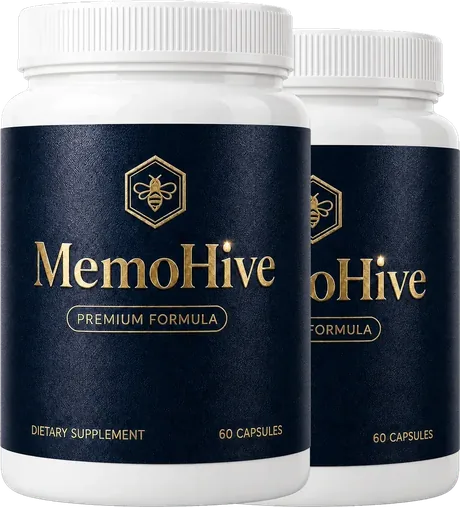
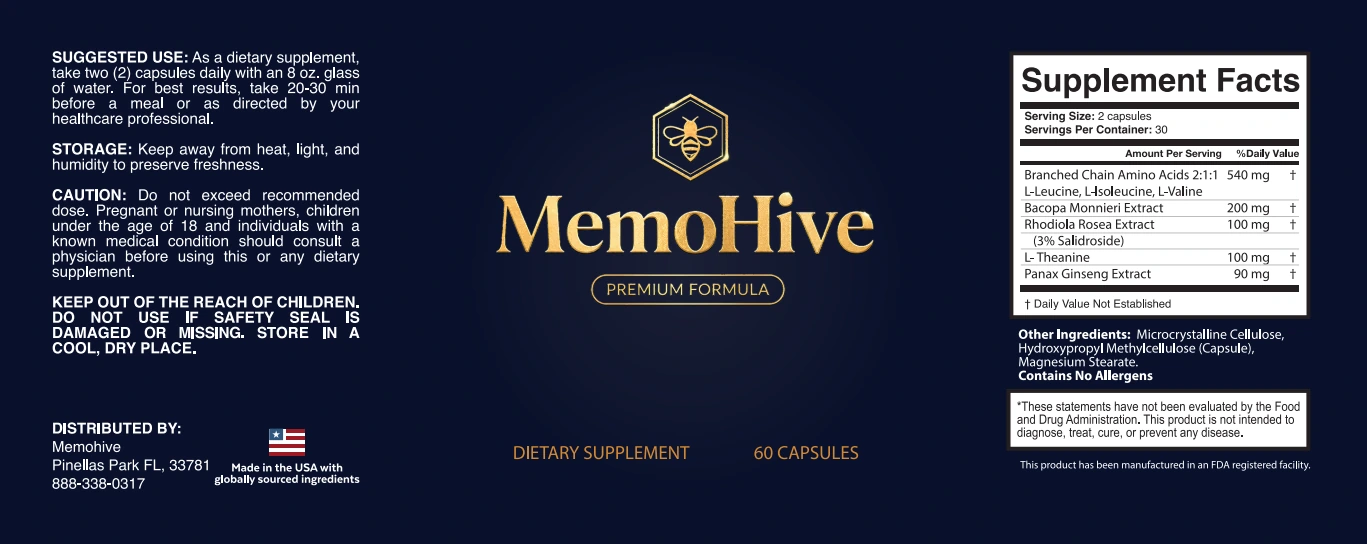
Two capsules once daily, 60 capsules and 30 servings a bottle, five printed amounts and a printed total. Worldwide shipping, and the seller publishes a maximum delivery time of 30 days.
Order MemoHiveThe two medication notes that are specific enough to act on
Most supplement safety writing is a list of maybes. Two items on this row are specific, and they are the two most useful sentences on the whole panel.
A review of herb interactions with cardiovascular drugs collected 43 case reports and eight clinical trials. Warfarin was the drug that came up most often, and ginseng appears on its list of herbs reported to reduce that drug’s anticoagulant effect. The reviewers put people on anticoagulants at the highest risk of any herb-drug interaction in the set they examined. Case reports are not a mechanism and not a magnitude, and they do not establish that anything will happen. They are the reason to mention it before the first capsule rather than after.
The meta-analysis of ginseng and glycaemic control is why the blood-sugar note is not boilerplate. Across sixteen trials, ginseng lowered fasting blood glucose by 0.31 mmol/L against control, in people with and without diabetes. Most of those trials ran under twelve weeks. On its own that is a small effect. On top of a medicine that already lowers blood sugar, a small effect is exactly the kind worth knowing about.
The NCCIH page on Asian ginseng gathers the rest. Short-term oral use of up to six months in recommended amounts appears to be safe for most people; insomnia is the most commonly reported side effect; and the page states that ginseng may lower blood sugar levels, may interfere with blood clotting and may worsen autoimmune disorders.
| Finding | What the source reports | What it is |
|---|---|---|
| Anticoagulants | A review of 43 case reports and eight clinical trials puts ginseng on the list of herbs reported to reduce warfarin’s effect. | Case reports. Enough to raise with a prescriber, not enough to predict. |
| Blood glucose | Fasting blood glucose fell by 0.31 mmol/L against control across sixteen trials, in people with and without diabetes. | A pooled trial result. Modest on its own, and additive with a medicine that does the same thing. |
| General safety | Short-term oral use up to six months in recommended amounts appears safe for most people, with insomnia the commonest reported side effect. | A government summary of the whole record, including the clotting and autoimmune cautions. |
These three belong to the plant. None of the sources behind them prints an amount that maps onto 90 mg, which is the reason they are raised as conversations rather than as thresholds.
What 90 mg is, read honestly
The smallest row on this panel turns out to be the one where the printed amount matters least and the ingredient matters most, and the two facts have the same cause.
No comparison is available, because the trials never settled on a dose to compare with. That is not a gap in this label, which prints its 90 mg plainly, and it is not something a better label could fix. It is the state of the published work.
The safety notes, meanwhile, travel with the plant rather than with the amount. Neither the case-report review nor the glucose meta-analysis prints a figure that can be lined up against 90 mg, so nobody can say that 90 mg is or is not enough to matter to a person taking warfarin or a diabetes medicine. The honest response to that is to raise it rather than to reason around it, which is why both notes appear on the safety page as well as here.
For everything else on this panel the comparison exists and is printed. The ingredients page carries all five rows with the research amounts beside them, and this row is the one where the research column says what it cannot do.
What this is, and what it is not. MemoHive is a dietary supplement. It is not a medicine, it is not a treatment for any condition, and nothing on this page describes it as one. Every study named here tested a single ingredient, at its own amount, in its own group of people, and none of them tested this formula. Memory or thinking that is changing in a way that worries you is worth raising with a clinician rather than answering with a capsule.
Sources cited in this article
- Geng J, Dong J, Ni H, Lee MS, Wu T, Jiang K, Wang G, Zhou AL, Malouf R. Ginseng for cognition. Cochrane Database Syst Rev. 2010;(12):CD007769. PMID 21154383. https://pubmed.ncbi.nlm.nih.gov/21154383/
- Zeng M, Zhang K, Yang J, Zhang Y, You P, Yan L, Weng Y. Effects of Ginseng on Cognitive Function: A Systematic Review and Meta-Analysis. Phytother Res. 2024;38(12):6023-6034. PMID 39474788. https://pubmed.ncbi.nlm.nih.gov/39474788/
- Izzo AA, Di Carlo G, Borrelli F, Ernst E. Cardiovascular pharmacotherapy and herbal medicines: the risk of drug interaction. Int J Cardiol. 2005;98(1):1-14. PMID 15676159. https://pubmed.ncbi.nlm.nih.gov/15676159/
- Shishtar E, Sievenpiper JL, Djedovic V, Cozma AI, Ha V, Jayalath VH, Jenkins DJ, Meija SB, de Souza RJ, Jovanovski E, Vuksan V. The effect of ginseng (the genus panax) on glycemic control: a systematic review and meta-analysis of randomized controlled clinical trials. PLoS One. 2014;9(9):e107391. PMID 25265315. https://pubmed.ncbi.nlm.nih.gov/25265315/
- National Center for Complementary and Integrative Health, National Institutes of Health. Asian Ginseng: Usefulness and Safety. Last updated February 2025. https://www.nccih.nih.gov/health/asian-ginseng
- European Medicines Agency, Committee on Herbal Medicinal Products. Ginseng radix - herbal medicinal product. European Union herbal monograph, revision 1. https://www.ema.europa.eu/en/medicines/herbal/ginseng-radix