MemoHive Official Website › Dose Notes › How does MemoHive work?
How Does MemoHive Work? The Five Ingredients and What Each One Is Studied For
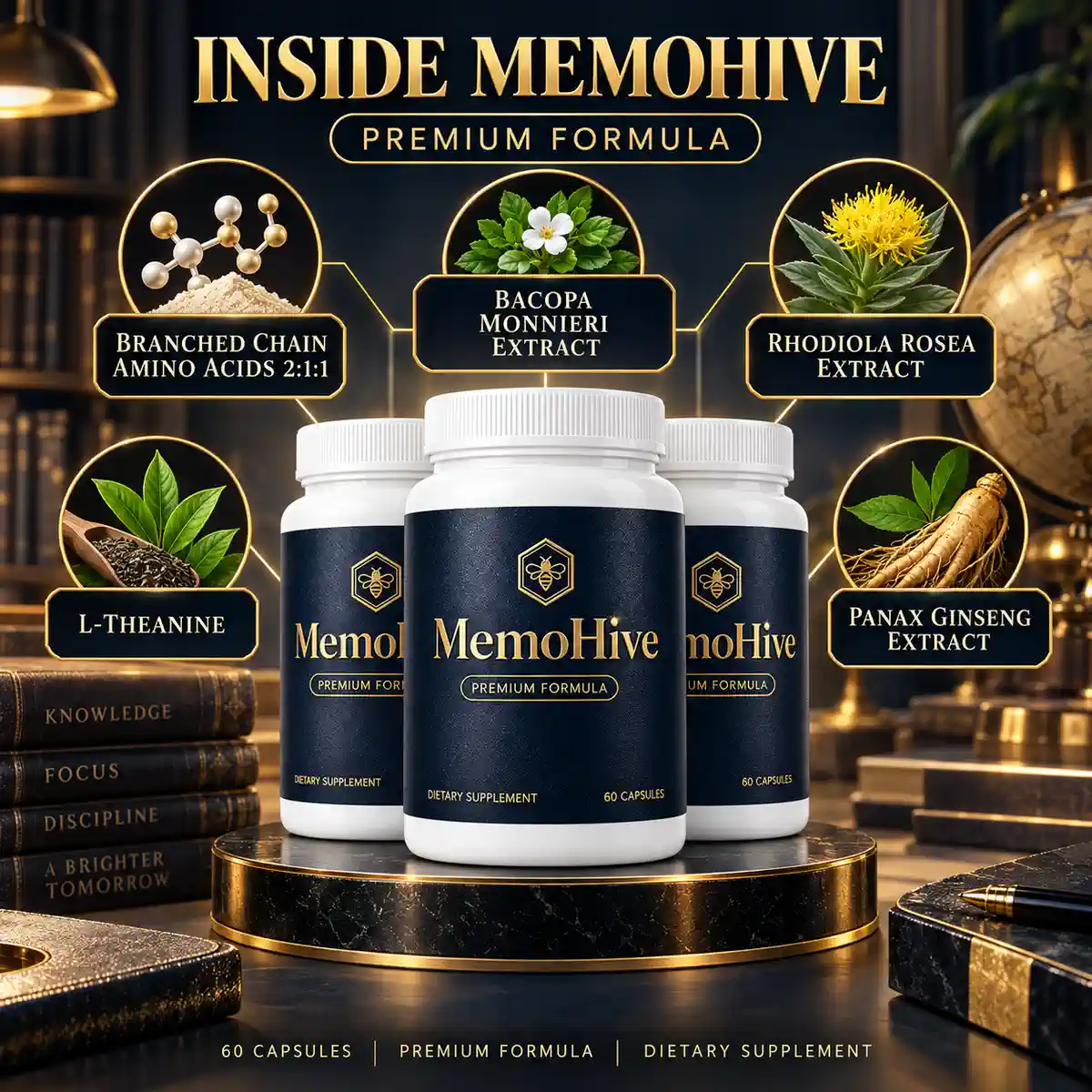
MemoHive does not work through one mechanism. It combines five ingredients, each studied for something different. Bacopa has a memory literature and is the slowest. L-theanine and rhodiola are studied for reaction time and fatigue. Branched chain amino acids come from muscle research. Ginseng has modest, mixed evidence. No trial has tested the finished capsule.
Key facts
- Five ingredients, five different jobs. There is no single mechanism for the whole capsule.
- Bacopa: studied for memory free recall over twelve weeks. It has the largest research record of the five.
- L-theanine and rhodiola: studied for reaction time and for fatigue and stress, not for memory.
- Branched chain amino acids: 540 mg, the biggest row, from an exercise literature. NIH says their brain effect "has not been well studied".
- The finished capsule is untested. Each study cited looked at one ingredient at its own dose.
How does MemoHive work?
Start with a small correction. The question suggests one mechanism, and there is not one. MemoHive is a mix of five separate ingredients. Each has been studied for a different thing. So the fairest answer is a tour of the five.
The label says the product supports memory and mental clarity, the kind of statement a dietary supplement may make about a normal body function. It claims to treat or cure nothing, and MemoHive is not FDA approved.
People sometimes call products like this "nootropics" or "cognitive support". Those are search words. The label itself uses memory and mental clarity, and that is the wording this page follows.
| Ingredient | Amount per serving | Studied for | Speed |
|---|---|---|---|
| Bacopa monnieri extract | 200 mg | Memory free recall | Slow. Twelve weeks in the trials. |
| L-theanine | 100 mg | Simple reaction time | Same day, but small. |
| Rhodiola rosea extract (3% salidroside) | 100 mg | Fatigue and stress | 28 days to twelve weeks in the trials |
| Panax ginseng extract | 90 mg | Thinking skills, with mixed results | Varied across trials |
| Branched chain amino acids 2:1:1 | 540 mg | Muscle and strength; little on thinking | Weeks in muscle studies |
What does bacopa do, and why is it the main character?
Bacopa is the ingredient with systematic reviews behind it. The 2012 review pooled six trials and found better scores on 9 of 17 tests of memory free recall. Free recall means producing a list back from memory with no prompts. Little changed in other areas.
The catch is the dose and the time. Those six trials used 300 to 450 mg a day, and all ran twelve weeks. MemoHive prints 200 mg and no standardisation. And a 2025 trial that gave 300 mg for twelve weeks found no difference from placebo on its main measures. So bacopa is the best-studied row, but it is not a sure thing.
What do L-theanine and rhodiola add?
L-theanine is an amino acid from tea leaves. A 2023 crossover study of 32 healthy adults found that 100 mg sped up simple reaction time by about 16 ms, while sustained attention and inhibitory control stayed flat. It is the one row on the label whose amount matches an amount a study tested.
Rhodiola is studied for tiredness and stress. The two trials that state a dose gave 400 mg a day for twelve weeks and 576 mg a day for 28 days. MemoHive prints 100 mg. The rhodiola row is also the only one with a standardisation printed: 3% salidroside, which makes 3 mg of salidroside from 100 mg of extract.
Why this matters. Reaction time and tiredness are not memory. Two of the five rows are studied for things next door to what the label claims, not the thing itself.
What do the branched chain amino acids do here?
They are the biggest row by weight, at 540 mg of the 1,030 mg serving. The label gives the ratio 2:1:1 for leucine, isoleucine and valine. By arithmetic that is about 270 mg of leucine and 135 mg each of the other two.
Their research lives in sport and muscle. Short studies used 10 to 14 g a day, and this serving is 540 mg. For thinking skills, the one systematic review found eight studies. Five showed no change. One suggestion is that they compete with tryptophan for the carrier that moves them into the brain. The NIH Office of Dietary Supplements says that effect has not been well studied.
Curious enough to look?
Five ingredients with every amount printed. If that suits you, the checkout shows the live price and the 60-day guarantee.
See today’s price and guaranteeDisclosure: Gomemohive earns a commission on orders placed through this website.
What about panax ginseng?
Ginseng is the smallest row, at 90 mg. The Cochrane review could not pool its trials, because the doses, durations and measures all differed. It found no convincing evidence of a thinking effect in healthy people. A 2024 meta-analysis found a small memory benefit in pooled trials of 671 people, but those people were not all healthy adults.
Ginseng is also the row with the one interaction worth raising: it is reported to reduce the effect of warfarin.
What does the evidence not cover?
- The finished capsule. No published clinical trial covers it.
- The five together. No study has tested these five at these amounts as a group.
- Your own results. Individual results vary, and sleep, food, exercise and prescribed treatment still matter.
One review looked at nine ingredients that each had at least three studies. Its verdict was inconsistent, imprecise and often methodologically flawed work. That speaks to certainty, not to proof of no effect, and it is the right frame for the whole table above.
So how does it all add up?
The most careful reading is that MemoHive is a five-part formula where one part, bacopa, has real research behind it at higher amounts, one part, L-theanine, matches a tested amount, and three parts are studied for other things or have thin evidence. Taken together they are a reasonable thing to try for a few months, not a proven memory fix.
Frequently asked questions
How does MemoHive work?
It does not have one mechanism. It combines five ingredients, each studied for something different: bacopa for memory recall, L-theanine for reaction time, rhodiola for fatigue and stress, ginseng for thinking skills, and branched chain amino acids from muscle research.
Is MemoHive a nootropic?
The label calls it a dietary supplement for memory and mental clarity. Nootropic is a search word, not a label term. It is not a drug, and it carries no FDA approval.
Which MemoHive ingredient has the most evidence?
Bacopa. Two systematic reviews cover it, and every trial in them ran twelve weeks at 300 to 450 mg a day. MemoHive prints 200 mg.
Has MemoHive been tested in a clinical trial?
No. Only single ingredients have been tested, never this capsule as a whole. The studies cited each looked at one ingredient.
Why are branched chain amino acids in a memory supplement?
They are the biggest row by weight, but their research is mostly about exercise. The one systematic review on thinking skills found eight studies, and five showed no change.
Does MemoHive work quickly?
No. Buyers mostly wait 4 to 8 weeks, and every bacopa trial lasted twelve.
Our view
We think the best way to understand MemoHive is as five small bets in one capsule. One bet, bacopa, has real research behind it, though at a higher amount than the label prints. One, L-theanine, matches a tested amount. The other three lean on research about different things.
That is not a reason to dismiss it. It is a reason to be patient, keep modest hopes and use the 60-day window as a test. If you have a health condition or take medicine, talk to a doctor before you start.
Want to look at the offer?
You can read the full panel and the live price on the official website before deciding anything.
See today’s price and guaranteeDisclosure: Gomemohive earns a commission on orders placed through this website.
Sources named in this article
- Pase MP, Kean J, Sarris J, Neale C, Scholey AB, Stough C. The cognitive-enhancing effects of Bacopa monnieri: a systematic review of randomized, controlled human clinical trials. J Altern Complement Med. 2012;18(7):647-52. PMID 22747190. https://pubmed.ncbi.nlm.nih.gov/22747190/
- Lopresti AL, Smith SJ. The Effects of a Bacopa monnieri Extract (Bacumen) on Cognition, Stress, and Fatigue in Healthy Adults: A Randomized, Double-Blind, Placebo-Controlled Trial. Clin Drug Investig. 2025;45(12):967-982. PMID 41091332. https://pubmed.ncbi.nlm.nih.gov/41091332/
- Dassanayake TL, Wijesundara D, Kahathuduwa CN, Weerasinghe VS. Dose-response effect of L-theanine on psychomotor speed, sustained attention, and inhibitory control: a double-blind, placebo-controlled, crossover study. Nutr Neurosci. 2023;26(11):1138-1146. PMID 36263942. https://pubmed.ncbi.nlm.nih.gov/36263942/
- Kasper S, Dienel A. Multicenter, open-label, exploratory clinical trial with Rhodiola rosea extract in patients suffering from burnout symptoms. Neuropsychiatr Dis Treat. 2017;13:889-898. PMID 28367055. https://pubmed.ncbi.nlm.nih.gov/28367055/
- Olsson EM, von Scheele B, Panossian AG. A randomised, double-blind, placebo-controlled, parallel-group study of the standardised extract SHR-5 of the roots of Rhodiola rosea in the treatment of subjects with stress-related fatigue. Planta Med. 2009;75(2):105-12. PMID 19016404. https://pubmed.ncbi.nlm.nih.gov/19016404/
- NIH Office of Dietary Supplements. Dietary Supplements for Exercise and Athletic Performance: Fact Sheet for Health Professionals. Updated 1 April 2024. https://ods.od.nih.gov/factsheets/ExerciseAndAthleticPerformance-HealthProfessional/
- Majid H, Islam SU, Kohli S, Nidhi. Efficacy of branched chain amino acid administration on cognitive function: a systematic review. Nutr Neurosci. 2026;29(5):579-594. PMID 41194744. https://pubmed.ncbi.nlm.nih.gov/41194744/
- Geng J, Dong J, Ni H, Lee MS, Wu T, Jiang K, Wang G, Zhou AL, Malouf R. Ginseng for cognition. Cochrane Database Syst Rev. 2010;(12):CD007769. PMID 21154383. https://pubmed.ncbi.nlm.nih.gov/21154383/
- Zeng M, Zhang K, Yang J, Zhang Y, You P, Yan L, Weng Y. Effects of Ginseng on Cognitive Function: A Systematic Review and Meta-Analysis. Phytother Res. 2024;38(12):6023-6034. PMID 39474788. https://pubmed.ncbi.nlm.nih.gov/39474788/
- Izzo AA, Di Carlo G, Borrelli F, Ernst E. Cardiovascular pharmacotherapy and herbal medicines: the risk of drug interaction. Int J Cardiol. 2005;98(1):1-14. PMID 15676159. https://pubmed.ncbi.nlm.nih.gov/15676159/
- Crawford C, Boyd C, Deuster PA. Dietary Supplement Ingredients for Optimizing Cognitive Performance Among Healthy Adults: A Systematic Review. J Altern Complement Med. 2021;27(11):940-958. PMID 34370563. https://pubmed.ncbi.nlm.nih.gov/34370563/
Last updated November 4, 2026