MemoHive Official Website › Dose Notes › 540 mg of BCAAs
540 mg Of Branched Chain Amino Acids, Against What Has Actually Been Studied
More than half of this serving by weight is the ingredient with the smallest research record of the five. That is an odd sentence for a retailer to write and it is the most useful one on this website, because both numbers behind it are published and anybody can check them.
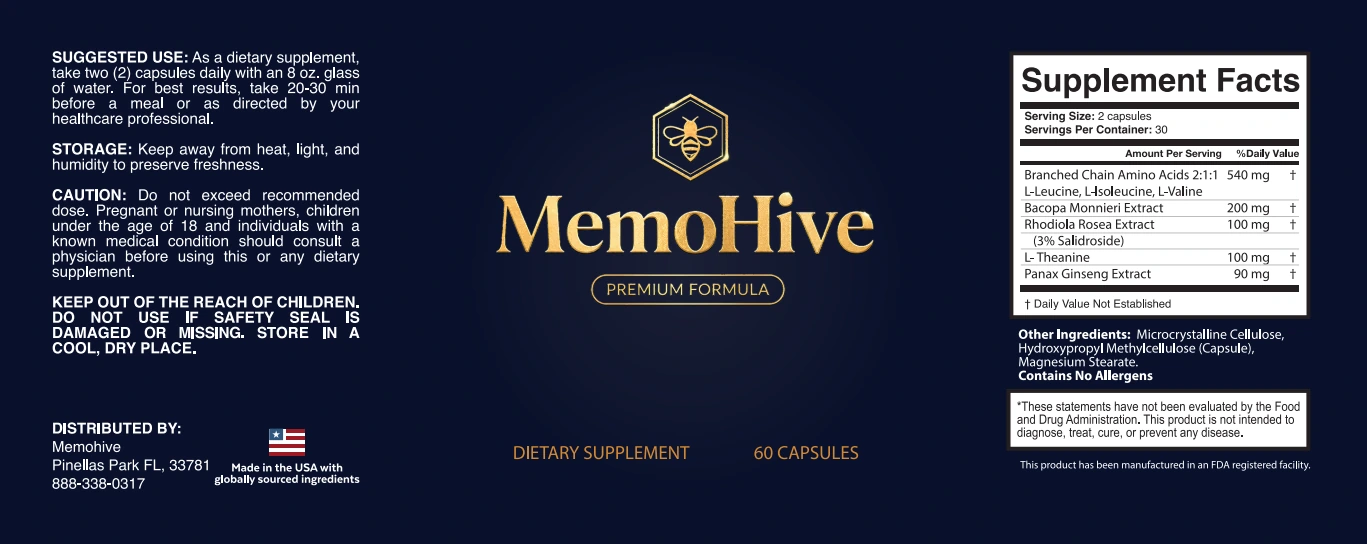
- 540 mg of a 1,030 mg serving. The largest single amount on the panel, and a little over half the total declared weight.
- Eight studies. 353 people. The entire published literature on branched chain amino acids and cognitive function, as counted by the only systematic review of it. Five of the eight found no significant change.
- 10 to 14 grams a day. What the short-term muscle and strength studies used. This serving is about a twentieth of the low end of that, which is arithmetic on two published figures.
- The mechanism runs both ways. The transporter that carries branched chain amino acids into the brain is the one that carries tryptophan and tyrosine, so more of one means less of the others.
Why 540 mg is the number to start with
The MemoHive panel declares 1,030 mg across five rows. Branched chain amino acids take 540 mg of that, which is more than the other four rows put together and a little over half the serving by weight.
The label also prints the ratio, 2:1:1, and names the three aminos on the line beneath: L-leucine, L-isoleucine and L-valine. A 2:1:1 ratio puts leucine at half the total, so 540 mg works out at roughly 270 mg of leucine and 135 mg each of isoleucine and valine. That is arithmetic this desk did from a ratio the label prints, not a figure the label prints, and it is flagged as arithmetic every time it appears.
The amount is on the panel at all because 21 CFR 101.36 requires the quantitative amount by weight per serving of every dietary ingredient that is not a listed nutrient. The rule lets a proprietary blend print one total in place of a split, and this formula does not take that option. So the biggest row on the label is also a checkable one, which is the only reason the rest of this post can be written.
The whole published record on BCAAs and cognitive function
There is exactly one systematic review of branched chain amino acids and cognitive function, it was published in 2026, and its findings are mostly a description of how little there is to review.
Majid and colleagues screened forty-one studies and found eight that met the inclusion criteria, covering 353 participants in total. Five of the eight found no significant change in cognitive function after branched chain amino acids were given. Three reported improvements. The review’s own conclusion is that some studies suggest potential detrimental effects while others find no significant impact, and that larger, rigorously designed clinical trials are needed.
Read the first half of that conclusion carefully, because it is easy to over-report in either direction. Reviewers noting a signal is not reviewers establishing one, and nothing in that paper shows branched chain amino acids harm cognition any more than it shows they help it.
Three hundred and fifty-three people is the number worth holding on to. It is the whole literature, across every dose and every population anyone has tested.
| Row on the panel | Largest synthesis of it | People in that synthesis | Printed here |
|---|---|---|---|
| Branched Chain Amino Acids 2:1:1 | Eight studies, all that qualified out of forty-one screened | 353 | 540 mg per serving |
| Bacopa Monnieri Extract | Twenty-nine randomised trials | 2,107 | 200 mg per serving |
Set side by side to show the shape of the evidence rather than to rank the ingredients. The row with the most weight on the label has the least published work behind it for what this product is sold for, and the row with the most published work has less than half its weight.
The amounts the muscle studies used
Branched chain amino acids are an exercise and muscle-protein literature. That is not a criticism of the ingredient; it is where the research lives, and it is where the amounts come from.
The NIH Office of Dietary Supplements summarises it for health professionals. Several short-term studies lasting about three to six weeks suggest that roughly 10 to 14 grams a day of supplemental branched chain amino acids might improve gains in muscle mass and strength during training, and up to 20 grams a day in divided doses appears to be safe. The same fact sheet is careful about how much that establishes: studies have not consistently shown that taking branched chain amino acids, or any of the three singly, enhances athletic performance, builds muscle mass or aids recovery.
Ten grams is 10,000 milligrams. This serving is 540, which is a little under a twentieth of the low end of that range. Both figures are published and the division is the reader’s to do.
One more line from that fact sheet keeps the section in proportion. Branched chain amino acids make up about a quarter of the amino acids in foods containing complete proteins, which means meat, poultry, fish, eggs and milk. Anyone eating protein is already taking them, in grams rather than milligrams.
| Amount | What it is | Where it comes from |
|---|---|---|
| 10 to 14 g a day | What the short-term muscle mass and strength studies used, over three to six weeks. | NIH Office of Dietary Supplements |
| Up to 20 g a day | In divided doses, the amount the same fact sheet describes as appearing to be safe. | NIH Office of Dietary Supplements |
| 700 to 3,000 mg of leucine | What an acute protein dose should contain, inside a 20 to 40 g dose of protein. | the sports nutrition position stand |
| 540 mg per serving | The amount this label prints, of which roughly 270 mg is leucine by arithmetic from the printed 2:1:1 ratio. | The printed panel |
Three published figures and one printed one. The arithmetic in the last row uses the ratio on the label and nothing else, and it is the only line in this table the panel itself does not state.

See the whole MemoHive panel
Five ingredients, five printed amounts, 1,030 mg a serving, and the largest row named first. The panel and the pack prices are both on the official website.
Order MemoHiveThe mechanism, written in both directions
There is a mechanism behind the focus claim, it is real, and it does not point in one direction only.
Fernstrom’s 2005 review sets it out. Branched chain amino acids and the aromatic amino acids share a single competitive transporter at the blood-brain barrier. Raising the branched chain amino acids in the blood raises them in the brain and lowers brain tryptophan, tyrosine and phenylalanine, and with them the synthesis of serotonin, dopamine and the other catecholamines. The same competition that produces the focus story also reduces the supply of the precursors for mood and sleep chemistry.
The review is candid about the size of the hole in the middle of it. Few attempts have been made to characterise time-course or dose-response relations for those effects, and no study has tried to identify intakes that might produce adverse effects on the brain. So the mechanism describes a direction and not a threshold.
The ODS fact sheet says the same thing in one sentence, and the sentence has to be quoted whole: branched chain amino acids “might delay feelings of fatigue or help maintain mental focus by competing with the amino acid tryptophan ... for entry into the brain, but this effect has not been well studied.” The clause after the comma is part of the claim, and quoting the first half without it would be quoting a different sentence.
What 540 mg honestly is
Pulling the four sections together gives a position that is neither a defence nor an accusation.
Five hundred and forty milligrams is far below any amount that has been studied for anything, in either literature. In the exercise work it is a twentieth of the low end. In the cognitive work there is no pooled amount to compare it with, because eight studies across 353 people do not produce one.
That is fairly a reason it is unlikely to cause trouble, and it is also the reason nobody should expect much from it. Both readings come from the same two facts, and this desk prints both rather than picking the flattering one.
The review that tested supplement marketing against the science makes the general version of the point: across nine ingredients with at least three studies each, the work is inconsistent, imprecise and often methodologically flawed. What that describes is how confident anyone can be, not which way the answer falls, and a 540 mg row resting on eight studies is the clearest case of it on this panel. The mechanism page carries the short version of all five rows.
What this is, and what it is not. MemoHive is a dietary supplement. It is not a medicine, it is not a treatment for any condition, and nothing on this page describes it as one. Every study named here tested a single ingredient, at its own amount, in its own group of people, and none of them tested this formula. Memory or thinking that is changing in a way that worries you is worth raising with a clinician rather than answering with a capsule.
Sources cited in this article
- Majid H, Islam SU, Kohli S, Nidhi. Efficacy of branched chain amino acid administration on cognitive function: a systematic review. Nutr Neurosci. 2026;29(5):579-594. PMID 41194744. https://pubmed.ncbi.nlm.nih.gov/41194744/
- NIH Office of Dietary Supplements. Dietary Supplements for Exercise and Athletic Performance: Fact Sheet for Health Professionals. Updated 1 April 2024. https://ods.od.nih.gov/factsheets/ExerciseAndAthleticPerformance-HealthProfessional/
- Fernstrom JD. Branched-chain amino acids and brain function. J Nutr. 2005;135(6 Suppl):1539S-46S. PMID 15930466. https://pubmed.ncbi.nlm.nih.gov/15930466/
- Jager R, Kerksick CM, Campbell BI, Cribb PJ, Wells SD, Skwiat TM, Purpura M, Ziegenfuss TN, Ferrando AA, Arent SM, Smith-Ryan AE, Stout JR, Arciero PJ, Ormsbee MJ, Taylor LW, Wilborn CD, Kalman DS, Kreider RB, Willoughby DS, Hoffman JR, Krzykowski JL, Antonio J. International Society of Sports Nutrition Position Stand: protein and exercise. J Int Soc Sports Nutr. 2017;14:20. PMID 28642676. https://pubmed.ncbi.nlm.nih.gov/28642676/
- Tiemtad P, Ingkaninan K, Temkitthawon P, Thimkorn P, Rattanachaisit N, Teaktong T, Dhippayom T. Comparative effects of Bacopa monnieri and Ginkgo biloba on cognitive functions: A systematic review and network meta-analysis. Phytomedicine. 2026;153:157915. PMID 41678913. https://pubmed.ncbi.nlm.nih.gov/41678913/
- Crawford C, Boyd C, Deuster PA. Dietary Supplement Ingredients for Optimizing Cognitive Performance Among Healthy Adults: A Systematic Review. J Altern Complement Med. 2021;27(11):940-958. PMID 34370563. https://pubmed.ncbi.nlm.nih.gov/34370563/